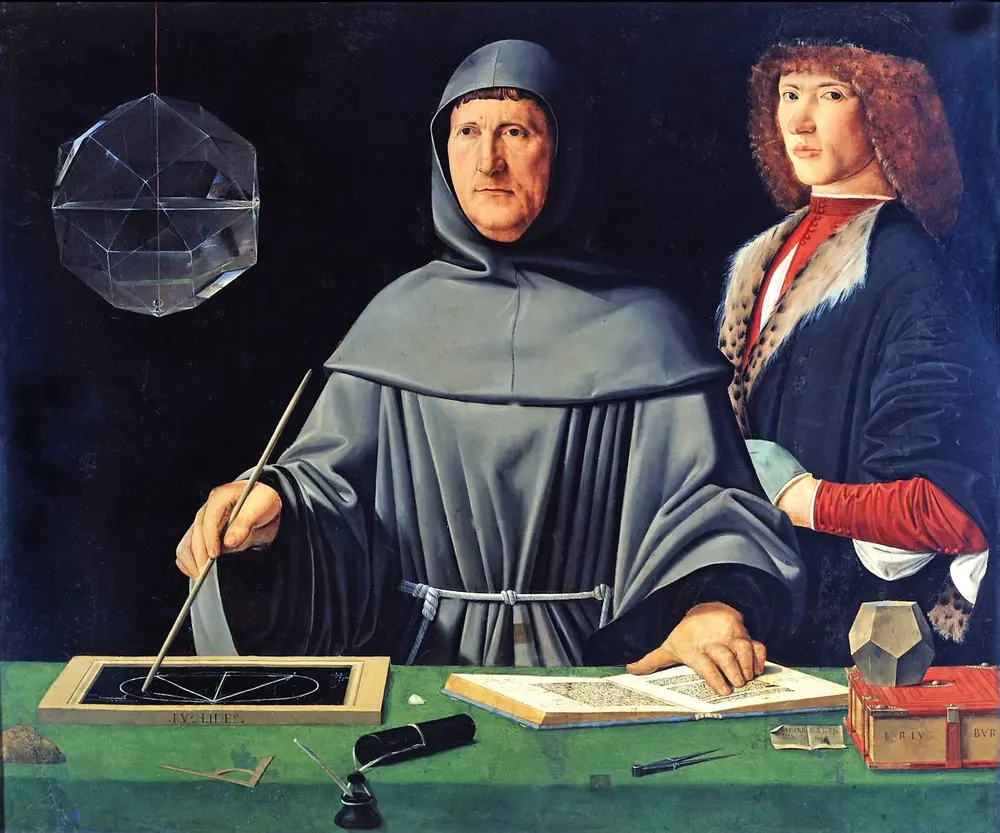
Portrait of Luca Pacioli
Jacopo de' Barbari
1497. Oil paint. 108×98 cm cm. Museo di Capodimonte, Naples, Italy.
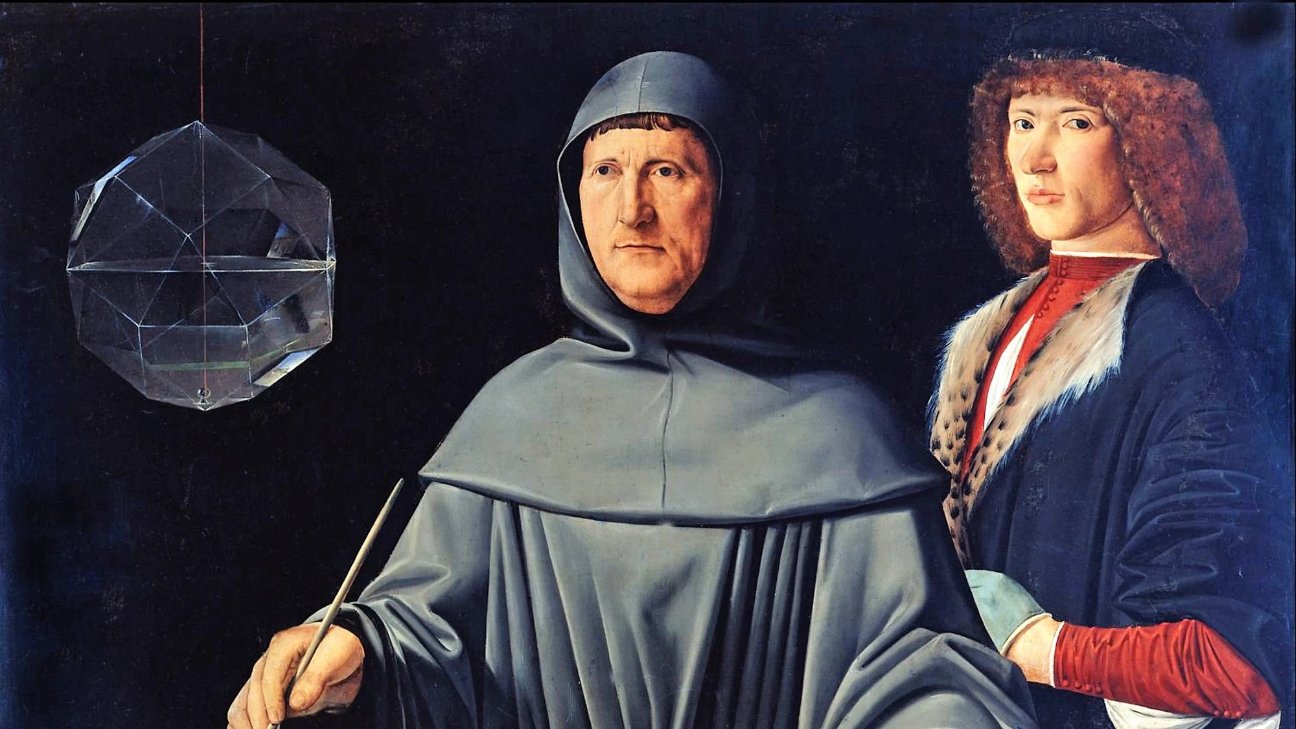
Painted in 1497, the "Portrait of Luca Pacioli" is a quintessential Renaissance masterpiece that beautifully illustrates the intersection of art, mathematics, and humanist philosophy. The painting depicts the renowned Franciscan friar and mathematician Luca Pacioli demonstrating a theorem by Euclid. Arranged on the green cloth of his desk are various geometric tools, a slate board, and a wooden model of a dodecahedron resting atop a copy of his famous treatise. Suspended in the upper left is a glass rhombicuboctahedron, half-filled with water, showcasing the artist's masterful command of perspective, optical refraction, and light. The identity of the young nobleman standing behind the friar remains a subject of scholarly debate, though many identify him as Pacioli's distinguished student, Guidobaldo da Montefeltro, the Duke of Urbino. Executed in oil on panel, the artwork is housed in the Museo di Capodimonte in Naples.
(source: wikidata.org)